
Memory Loss: Are You Addressing It the Right Way - for Yourself or Someone You Love?
Perhaps you’re concerned about your own memory. Or maybe you’re noticing the same changes in a parent, your partner, or someone close to you. Whatever the case - if names are becoming harder to recall, stories are being repeated, or words keep slipping away mid-sentence, read this before dismissing it as “just aging” or putting your faith in one of the viral “honey tricks” spreading online.
By Markus Davenport · Updated 28/08/2026 · 9 min read

Because the real danger isn’t a forgotten name. It’s watching small changes become increasingly hard to ignore while you keep telling yourself they’re “nothing”—or struggling to accept that someone you love may be going through the same thing.
And memory changes rarely affect just one person. They can slowly alter conversations, confidence, family moments, and the connection you share with the people you love most.
Maybe you know this feeling. Or maybe you’ve been watching it happen to someone close to you.
Maybe it’s you who walks into a room and suddenly forgets why you went there.
Or maybe you’ve watched a parent, your partner, or someone you love stop mid-step and try to remember what they were about to do.
Maybe you know exactly which word you want to say… but it seems to disappear just before it reaches your lips.
Or maybe you’ve noticed someone close to you pause in the middle of a sentence, searching for a word that used to come easily.
Maybe it’s your keys that end up somewhere “safe,” only for you to spend twenty minutes trying to remember where that safe place was.
Or maybe you’ve started noticing the same kinds of small moments happening to someone you care about.
Maybe you’ve tried brain games. Omega-3s. Ginkgo. Memory formulas. Or maybe you’ve bought them for someone you love, hoping something might help.
Maybe you’ve followed every recommendation you were given — or encouraged someone close to you to do the same.
And lately, perhaps you’ve seen the same strange idea appearing again and again online:
“Try the honey trick.”
Maybe you ignored it at first.
Maybe you dismissed it when someone mentioned it to you.
Then you saw it again.
And again.
Until, at some point, you had to ask yourself:
“Is there actually something behind this… or is it just another viral internet trick?”
Here is what I learned the hard way:
The honey idea was not the part that bothered me.
What bothered me was how the whole idea had been reduced to a homemade “trick” — as though finding one right ingredient was the same thing as understanding and following the method behind it.
That is not how anything important works.
You can have the right ingredients and ruin a recipe by using the wrong amounts.
The right exercise can get you nowhere if the technique is wrong.
Even the right tool can fail in the wrong hands.
The right thing, used the wrong way, can still produce the wrong result.
I Thought My Father Was Just Becoming Forgetful. Then It Became Impossible to Ignore.
For a long time, I thought they were just momentary lapses—that my father simply needed to pay a little more attention.
Later, when I started telling him his memory wasn’t what it used to be, he would push back. He’d remind me that he had always had the best memory of anyone in his family.
Yet every so often, he would admit that something felt different.
I kept telling myself it was probably just age. Nothing unusual. Nothing to worry about.

The moment the story stopped being theoretical: Markus watched the problem reach his own father.
Until, eventually, I had to face the truth: I was wrong.
My name is Markus.
I am not a celebrity. I am not a television doctor.
I am a researcher and formulator, and I have spent years following the small circle of scientists who study lithium biology, brain aging and the mechanisms that can interfere with memory.
That meant going back through older work most people had forgotten — including the early lithium-orotate work associated with German physician Dr. Hans Nieper — and following newer research from groups such as Dr. Bruce Yankner’s laboratory at Harvard Medical School.
I was not looking for a viral “trick.” I was trying to understand why certain ideas kept resurfacing decades apart.
And for most of my life, I was also the person in my family who remembered everything.
Names. Dates. Appointments. Conversations.
So when my father began repeating questions, losing words and quietly withdrawing from conversations, I made the mistake a lot of families make.
I thought he needed to focus harder.
I told him to write things down.
I encouraged him to exercise his mind more.
Then one day he looked at me and said something I will never forget:
“Markus, I AM trying. I do everything they tell me to do.”
That stopped me.
Because he was right.
He was not careless.
He was not lazy.
And he was not ignoring the advice he had been given.
So for two weeks, I tracked everything I could.
His routine. His sleep. His walks. The supplements and medications he was using. The moments when he lost a word, repeated a question or forgot something that once would have been automatic.
And one thing became impossible for me to ignore:
He was doing the “right things” — yet something was still getting in the way.

Two weeks of notes made one thing hard to ignore: effort was not the missing piece.
At 1:00 A.M., I Found the Research That Changed the Question I Was Asking.

That night, the question changed.
I had been asking:
“How can I make his memory work harder?”
The research pushed me toward a different question:
“What if the problem is not effort… but the environment those brain cells are trying to work in?”
I kept coming across research around cellular energy, insulin-related signaling in the brain, oxidative stress, and the ways environmental exposures can interfere with normal neuronal function.
One area kept getting my attention: cadmium exposure.
That did not prove that cadmium was the answer to every memory problem.
But it gave me a new hypothesis to investigate:
What if part of the problem was not simply “memory storage” — but the brain’s ability to access the energy and signaling it needs to retrieve what is already there?
That is when the key-and-lock analogy finally made sense to me.
Then I Found a Second Scientific Thread — One That Started More Than 50 Years Ago.

Back in the 1970s, German physician Dr. Hans Nieper became one of the earliest clinical advocates of lithium orotate.
Nieper proposed that orotic acid could act as a carrier, helping mineral compounds move across biological membranes more efficiently than conventional salts.
It was an unusual idea for its time.
And it never became mainstream medicine. Research interest faded for decades, and the idea largely remained outside mainstream attention.
But the idea never completely disappeared.
I kept coming back to one question:
Why lithium orotate? Why did this particular form keep resurfacing?
In 2025, a Harvard Team Published the Finding That Made the Old Lithium-Orotate Question Impossible to Ignore.
A team led by Dr. Bruce Yankner, Professor of Genetics at Harvard Medical School, published a major study in Nature examining naturally occurring lithium in the aging brain.
In human brain samples, the researchers found that lithium was already reduced in people with mild cognitive impairment — and that in Alzheimer’s disease, amyloid plaques appeared to sequester lithium, making less of it available to surrounding brain tissue.
Then came the part that caught my attention.
The researchers compared lithium salts and found that lithium orotate showed reduced binding to amyloid compared with conventional lithium carbonate.
In experimental Alzheimer’s models, low-dose lithium orotate was able to bypass much of that amyloid sequestration, reduce pathological changes and improve memory performance.
And in an advanced amyloid model, the researchers reported restoration of spatial memory in a navigation-based memory experiment.
This was not an internet testimonial.
It was a peer-reviewed 2025 Nature study from a Harvard-led research team.
But scientifically, the finding changed the conversation.
For the first time, modern research had provided a concrete reason why this particular lithium salt might behave differently in an amyloid-rich environment.
And suddenly, an idea that had been sitting on the edge of medicine for decades had a completely new scientific context.
Scientific references: Aron L. et al., “Lithium deficiency and the onset of Alzheimer’s disease,” Nature 645, 712–721 (2025); Harvard Medical School coverage of the Yankner laboratory findings.
Think of Your Brain Like a Building That Needs Fuel to Keep the Lights On.

A simple way to picture what Markus was seeing in the research.
Every conversation you follow, every name you retrieve and every story you tell requires energy.
One way to understand part of that process is to think of insulin signaling like a key-and-lock system.
The signal is the key.
The receptor is the lock.
And the goal is to keep the system working efficiently enough for the cell to do its job.
Now imagine that the lock becomes harder to use.
You can keep bringing more keys.
You can keep trying harder.
But if the system itself is not functioning the way it should, effort alone may not solve the problem.
That was the lens through which I started looking at everything my father had tried.
That Is When the Viral Honey “Trick” Started to Look Completely Different.
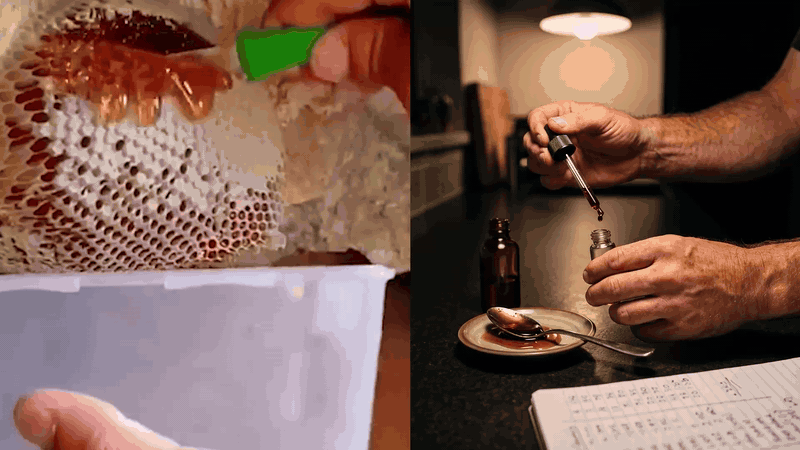
The online shortcut looked simple. The formulation did not.
Most viral versions made it sound almost ridiculous:
Take honey. Add it to this. Use it at this time. Done.
But that is not a protocol.
That is a shortcut.
And shortcuts become even less reliable when millions of people copy one another without knowing why each part was there in the first place.
So I started separating the idea into layers.
Once I looked at the viral versions side by side, the pattern became obvious.
The first videos reduced everything to a spoonful of honey. Then people copied the shortcut without knowing why the original ingredients had been chosen. Measurements disappeared. The second ingredient disappeared. Soon, completely different mixtures were all being called the same “honey trick.”
That explained why one person could swear by it while another said it did absolutely nothing: they were often not trying the same thing at all.
That distinction sounds simple.
But it explains something that bothered me for months:
Why could two people both say they “tried the honey trick” when they were actually using completely different methods, different ratios and different formulas?
Honey Was Only Part of the Story. The Second Step Was the Part Almost Everyone Left Out.
The formula I was working with had two different jobs.
The first centered around the honey-derived/polyphenol side of the protocol.
The second centered around lithium orotate — the same unusual lithium form that had interested Nieper decades earlier and that the Harvard-led 2025 study later found was less vulnerable to amyloid sequestration in the study’s experimental models.
That did not mean you could simply throw honey and a random lithium product together and expect the same thing.
Because the important part was never just the ingredient list.
It was the form, the amount, the relationship between the components, and the finished liquid formulation.
First clear what is getting in the way. Then protect the system from what keeps coming back. Only then does the fuel story make sense.
That was the working model behind the protocol.
The important part was no longer the spoonful of honey people saw online. It was what had been removed from the story before the idea reached them.
And this is where the versions circulating online started to fall apart.
Some used ordinary honey.
Some used only one side of the formula.
Some told people to estimate amounts at home.
Some copied another copy of another copy.
And once that happens, people stop testing the same thing.
They are testing dozens of different versions and calling all of them the “Honey Trick.”
The Ingredients Were Not the Secret. The Relationship Between Them Was.

The kitchen experiment eventually became laboratory work.
My first thought was probably the same as yours:
“If I know the ingredients, why not just buy them separately?”
So I tried.
And that is where the idea became much more complicated than the viral videos made it sound.
Natural honey is not standardized from one jar to the next.
The concentration of its compounds can vary.
A spoonful is not a precise measurement.
And lithium orotate is not something you want to estimate by eye.
The ratio matters.
The form matters.
The way the components are brought together matters.
But here is the part that matters to you:
You should not have to measure any of it.
No mixing. No calculating ratios. No kitchen experiments. No trying to remember which step comes first.
The complicated part belongs in the formulation — not in your morning.
That became my goal.
Make the formulation complicated enough to get right…
…and the routine simple enough to use in seconds.
Getting the ratio right took months. Using the finished formula should not.
That brought me back to the problem that started all of this: my father was already trying hard enough. The solution could not become another complicated routine he had to manage.
Then Something Happened That Made Me Realize the Internet Had a Bigger Problem Than “Fake Honey Tricks.”
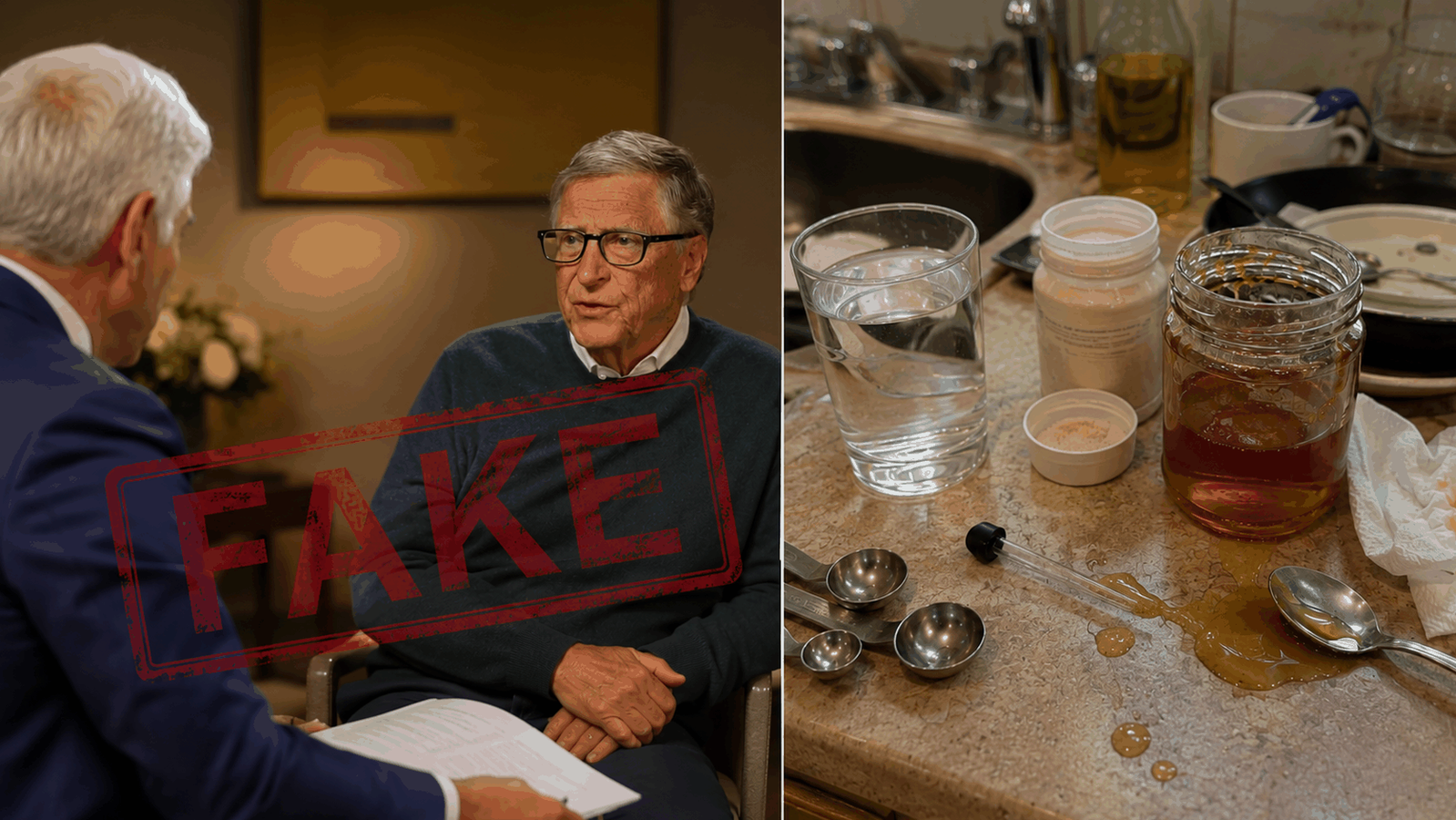
By the time the idea spread online, celebrity endorsements, the recipe, and the product itself had all become mixed together.
Once the honey idea started getting attention, the normal internet cycle began.
First, someone simplified it.
Then someone copied the simplified version.
Then another seller copied the copy.
Then familiar faces started appearing in ads they had nothing to do with.
And soon millions of people were seeing variations of the same “Honey Memory Trick” without any way to know whether two ads were even talking about the same thing.
They faked the celebrity.
Then they copied the trick.
Then they simplified the method.
And somewhere along the way, the original protocol disappeared.
This is important:
I cannot tell you what any celebrity, billionaire, actor or public figure uses privately.
And anyone who claims they can without proof should make you suspicious.
What I can tell you is that the formula I had been developing did not look like the ordinary golden-honey versions flooding the internet.
It had a distinctive appearance.
That Is Why the MemoFlow Formula Is Blue.

And then the visual clue finally appeared: the finished MemoFlow liquid was blue.
When the complete MemoFlow liquid formulation is brought together, it has a distinctive blue appearance.
And that gives you a very simple way to understand what we are talking about:
If the “honey memory formula” you tried was not the distinctive blue MemoFlow liquid, you were not using the true formulation.
That does not mean every other product is “fake.”
It means it is a different product, with a different formula, a different ratio or a different method.
And that may explain why someone can truthfully say:
“I tried the honey trick and noticed nothing.”
Because the question is not simply:
“Did you use honey?”
The better question is:
“Which method? Which protocol? Which formula?”
I called the finished blue liquid MemoFlow.
The goal was simple:
Take all the measuring, mixing and guesswork out of the process.
The complicated part is already inside the bottle.
Your part takes only seconds.
What I Saw in My Father Is Why I Kept Going.

The first changes showed up in ordinary moments.
I gave my father the formulation I had been working on.
I did not ask him to spend hours doing mental exercises.
I did not ask him to turn his kitchen into a laboratory.
I wanted the routine to be easy.
Then, little by little, I started noticing small things.
He would finish a story without losing his place.
He would call one of the grandchildren by name without the long pause that had started to embarrass him.
He seemed more willing to join conversations again.
Those changes mattered to me because they were not really about “performing better on a memory test.”
They were about something much bigger:
He was participating in his own life again.
The man who had started shrinking into silence at family dinners was telling stories again.
That is the part people miss when they talk about memory.
The fear is not simply losing your keys.
It is losing confidence in your own mind.
It is sitting quietly because you are afraid of repeating yourself.
It is asking someone else to come with you because you no longer trust yourself to handle something alone.
It is slowly becoming an observer in a life you used to lead.
That is what I wanted to fight against.

For Markus, this was the moment that mattered.
Three People. Three Different Moments That Mattered.

Different people described different moments that mattered to them.
★★★★★
Margaret W., 68 — Retired Teacher, Asheville, North Carolina
“I no longer freeze up in the middle of every conversation.”
Margaret described knowing exactly what she wanted to say but losing the word before she could finish the sentence. After using MemoFlow, she said those pauses began happening less often — and a long conversation with a former coworker felt like “getting my own voice back.”
★★★★★
Susan P., 74 — Retired, Mesa, Arizona
“My daughter looked at me and said, ‘Mom, you’re here again.’”
Susan said she had become quieter at family gatherings because she worried about repeating herself or forgetting a name. What mattered most to her was feeling comfortable enough to participate again.
★★★★★
Robert M., 73 — Grandfather of Three, Columbus, Ohio
“It wasn’t about the grocery store. It was about realizing I still had my independence.”
Robert described the confidence of handling an ordinary errand on his own again — something that had become emotionally much bigger than the errand itself.
The Difference Between “Knowing the Ingredients” and Having the Finished Formula
At this point, you know more about the honey trend than most people who have seen a dozen viral videos about it.
You know why “just use honey” is not the same as following a formulated protocol.
You know why a copied method can drift farther and farther from the original idea.
You know why DIY creates a measuring problem.
And you know why the MemoFlow formulation is visually distinctive.
So the decision becomes much simpler.
You can keep trying to recreate something from fragments online…
Or you can use the finished blue liquid where the measuring and ratio work have already been done.
Today, You Can Get MemoFlow for Just $19.99 Per Bottle.
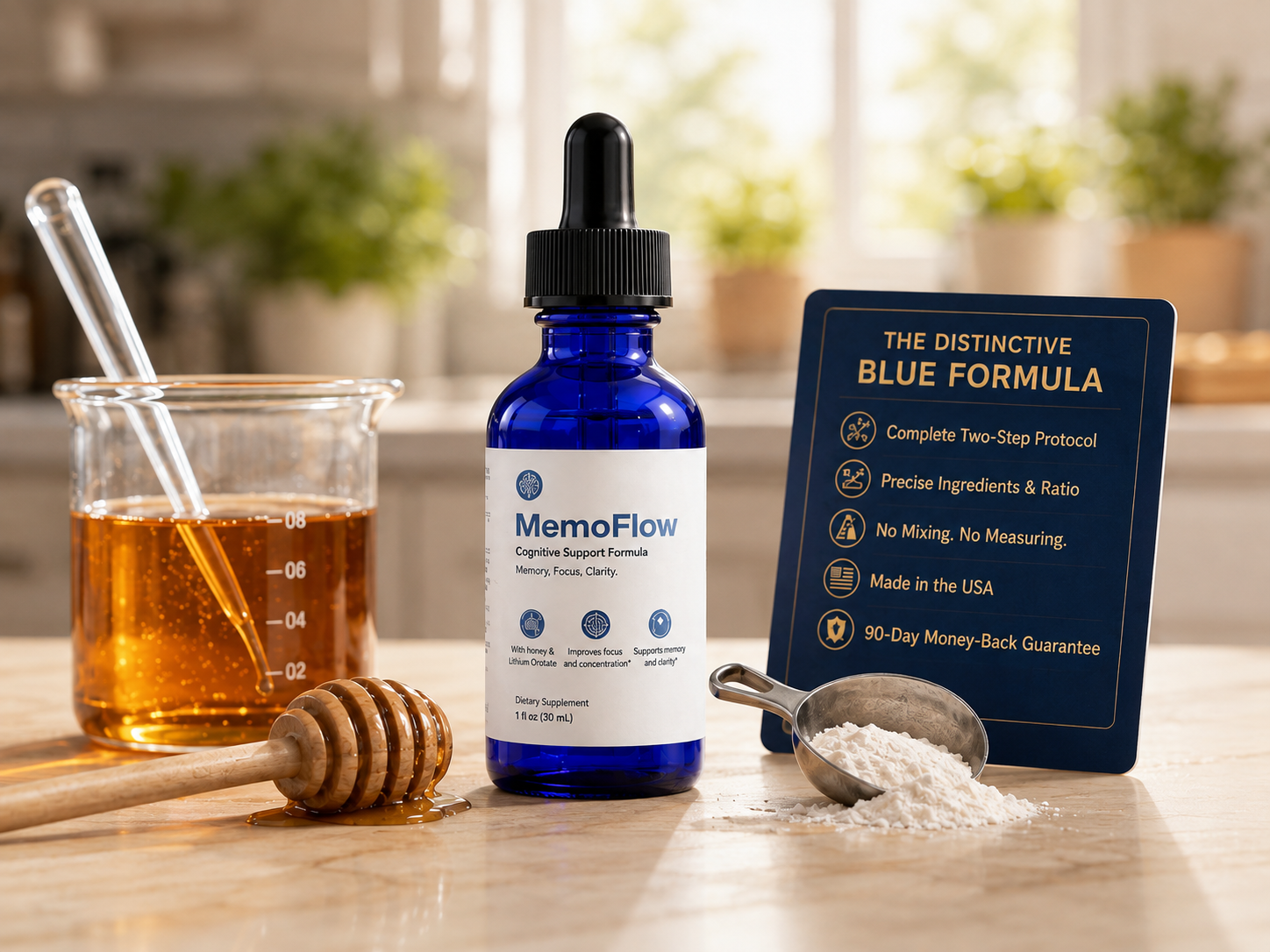
The finished MemoFlow liquid is presented as the simple alternative to measuring and mixing the ingredients yourself.
When we started working on MemoFlow, the plan was never to make it another premium memory product priced like a luxury item.
The point was to make the complete formula accessible enough that people would not feel pushed back toward random DIY versions simply because the finished product was too expensive.
Use MemoFlow as Directed. If You Are Not Satisfied, You Are Protected by the 90-Day Money-Back Guarantee.
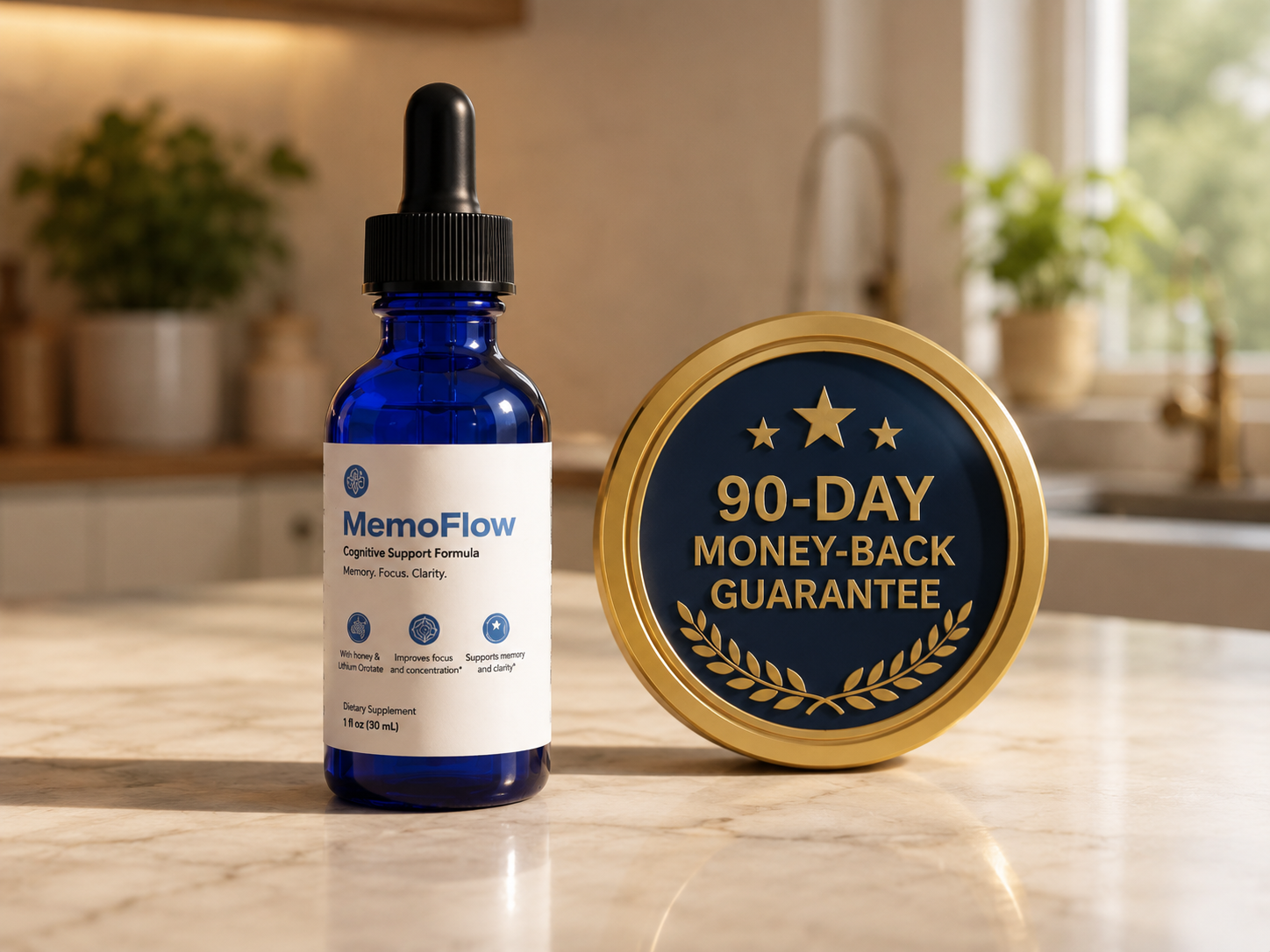
The current MemoFlow offer includes the producer’s 90-day money-back guarantee.
I know what it feels like to spend money on something and wonder whether you made another mistake.
That is why the current MemoFlow offer includes a 90-day money-back guarantee.
Use the product as directed.
Give yourself the opportunity to decide based on your own experience.
If you are not satisfied within the guarantee period, contact the support team according to the refund instructions provided with your order.

The Complicated Part Is Already in the Bottle.
You do not need another routine that takes twenty minutes.
You do not need another spreadsheet.
You do not need to measure powders, compare honey jars or calculate ratios.
Use MemoFlow exactly as directed on the label.
That is it.
The formula is complicated so your routine does not have to be.
Six months from now, you won't be thinking about this article. You'll be one of the satisfied people below!
Linda Brown
Susan Jones
johnson Brown
Jonh Smith
The question will be whether you did anything with the information.
Maybe you will still have the occasional moment when a word takes a second longer to arrive.
Everyone does.
But imagine feeling confident enough to stay in the conversation instead of quietly withdrawing.
Imagine telling the story instead of deciding it is safer to stay silent.
Imagine handling your ordinary routines without second-guessing every little thing.
Because memory is not only about facts.
It is about presence.
It is about confidence.
It is about remaining part of the moments that make your life yours.
If you have seen the Honey Trick before, now you know why the question was never simply whether honey was “real” or “fake.”
The better question was always:
The real question was never whether you had tried honey. It was whether you had tried the complete formulation.
And now you know the distinctive product we are talking about.
The blue one.
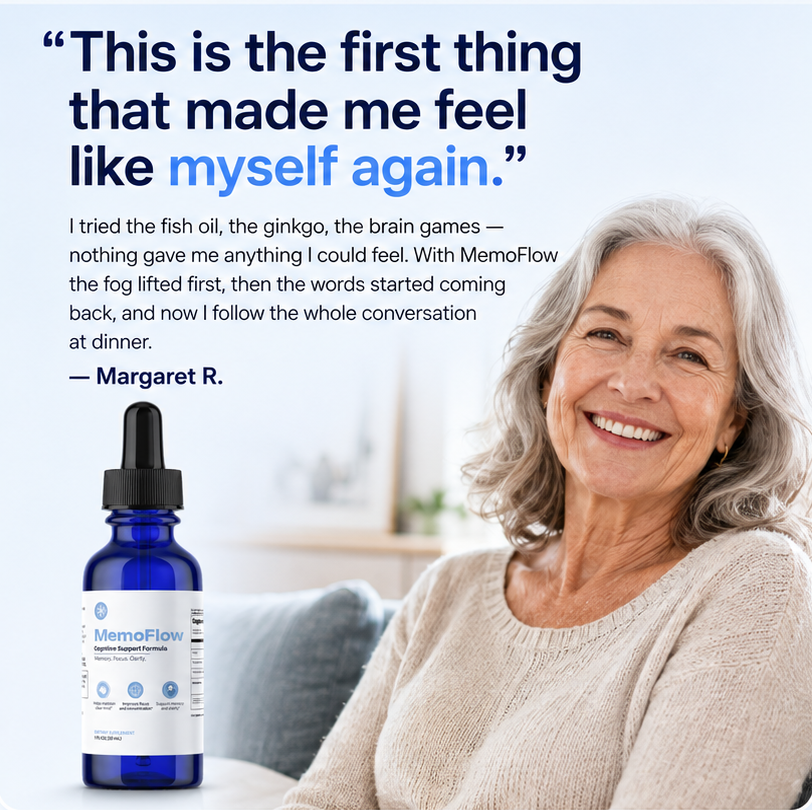
Do You Ever Know the Word… But Suddenly Can’t Pull It Out?
You know exactly what you want to say. The word feels like it is right there - familiar, almost within reach - but for a few frustrating seconds, you simply cannot find it.
Maybe you walk into a room and forget why you went there. Maybe you lose your train of thought halfway through a story. Maybe a name that once came instantly now takes longer to surface. Or perhaps you have started noticing these same little pauses in someone close to you.
Memory lapses that are becoming more frequent or noticeable should not simply be written off. In some people, these changes can gradually become more pronounced over time, affecting the brain systems involved in attention, signaling, and memory retrieval.
That matters because memory is not only about storing information. Your brain also has to access that information, organize it, and retrieve it at the exact moment you need it.
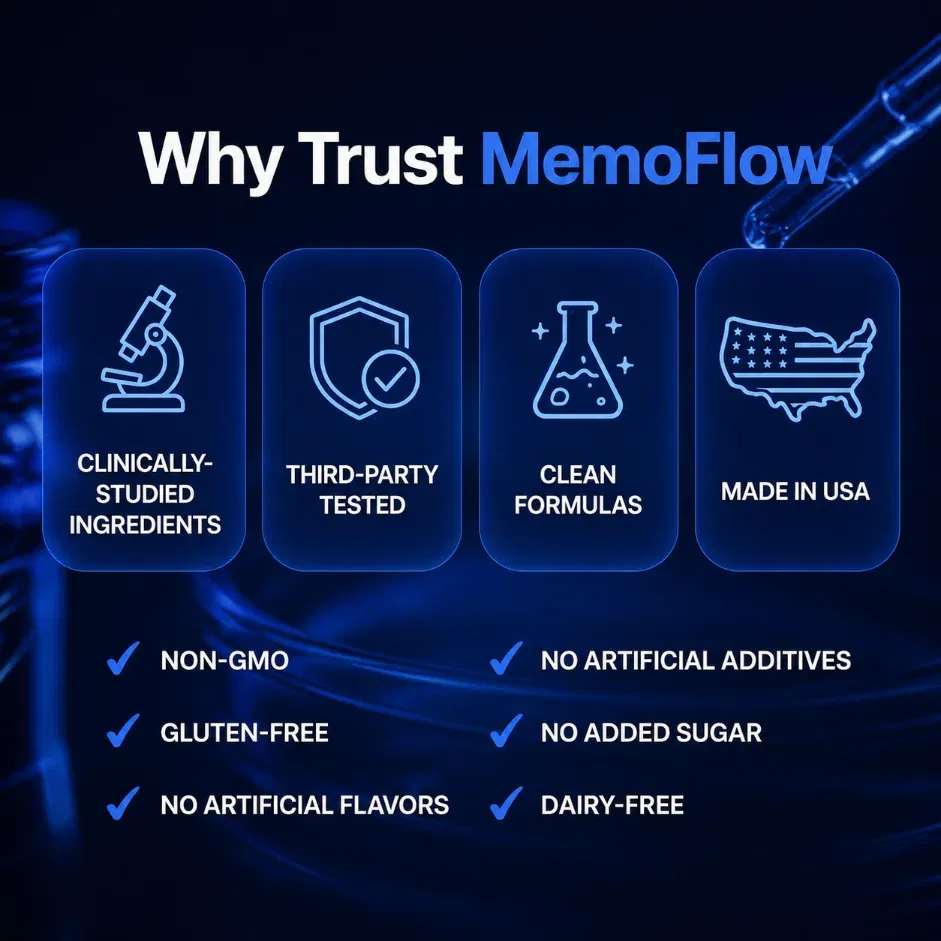
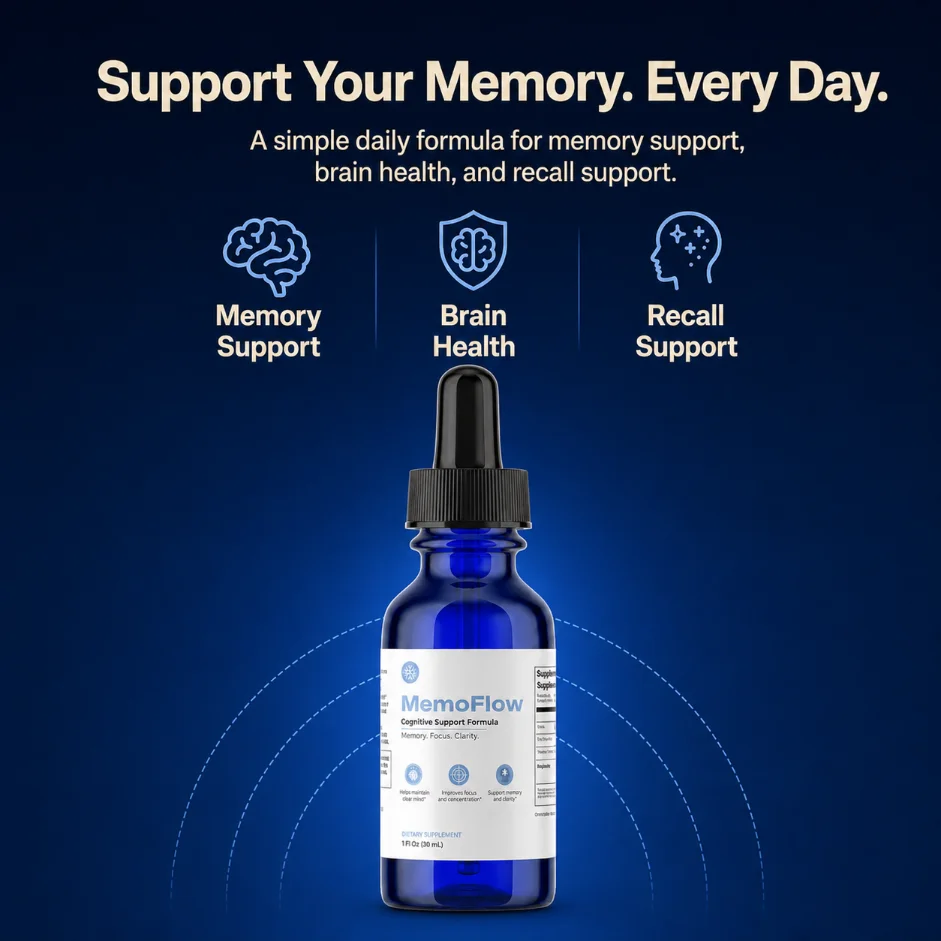
MemoFlow is designed to support this cognitive environment with ingredients selected for their roles in memory, mental clarity, cognitive signaling, and neuronal support.
So sometimes the information may still be there - but accessing it can feel slower, less automatic, and more frustrating than it once did.
Have You Started Trusting Your Memory Less Than You Used To?
Do you check things twice because you are not completely sure you remember doing them?
Do you write down simple reminders that you never needed before?
Do you sometimes stay quieter in a conversation because you worry you might repeat yourself, forget a name or lose your train of thought?
That change in confidence can become just as frustrating as the memory lapse itself.
Lithium naturally present in the brain plays a key role in preserving cognitive function with age.
In cognitive impairment, lithium availability drops, while amyloid deposits can trap this vital mineral and reduce the amount available to brain cells.
Lithium orotate behaves differently from conventional lithium salts and is associated with better memory performance.
MemoFlow includes lithium orotate as part of its cognitive-support formulation, together with honey-derived compounds selected to support the brain environment involved in memory, focus and clarity.
The idea is not simply to “stimulate” the brain for a few hours.
It is to support the biological systems your brain depends on to think clearly, retrieve information and stay mentally engaged.
You tried others and still have the same symptom.
If you have, there may be an important reason.
Having the right ingredient does not automatically mean you have the right formula.
Honey-derived compounds attract scientific interest because of their antioxidant, anti-inflammatory and neuroprotective properties.
But most viral “honey tricks” stop at the honey.
They leave out the second part of the story.
MemoFlow combines the honey-derived side of the formula with lithium orotate in a finished liquid formulation designed so you do not have to measure ingredients, calculate ratios or try to recreate a protocol in your kitchen.
No mixing.
No measuring.
No guessing.
The complicated part is already inside the bottle.
So if you tried a spoonful of honey, a homemade mixture or a different memory supplement before, that does not necessarily mean you tried the same formulation MemoFlow is built around.
The question is not simply, “Did I try honey?”
It is:
“Did I try the complete formula?”
What If I Don’t Like MemoFlow and Want My Money Back?
Every MemoFlow order is protected by a 90-Day Money-Back Guarantee.
That means you have up to 90 days to decide whether MemoFlow is right for you.
If you’re not satisfied for any reason, simply contact our support team and request a refund.
You do not need to send the product back. No bottles to ship. No boxes to repack. No complicated return process.
Just request your refund within the guarantee period.
You have 90 days to make your decision — without having to take all the risk yourself.
What If I’ve Already Tried Memory Supplements Before?
Maybe you’ve already tried omega-3s, ginkgo, brain games, memory formulas, or something else that promised to help.
And maybe you were disappointed.
So it’s completely reasonable to wonder why trying something else would be any different.
But as you’ve seen throughout this article, one ingredient is not the same as a complete formula — and two products with “memory support” written on the label are not necessarily built the same way.
The ingredients, amounts, formulation, and overall approach can all be different.
MemoFlow was designed as a multi-ingredient formula, with each component selected for its role in supporting memory, mental clarity, cognitive signaling, and neuronal health.
That doesn’t mean everyone will have the same experience.
It simply means that what happened with something you tried before does not automatically determine what your experience with MemoFlow will be.
And with the 90-day guarantee, you have time to decide that for yourself.
Am I Signing Up for a Subscription or Automatic Monthly Charges?
No hidden subscriptions. No surprise monthly charges.
When you place your order, you should know exactly what you are purchasing and exactly what you are being charged.
You will not suddenly discover an unexpected recurring charge simply because you decided to try MemoFlow.
What you choose at checkout is what you purchase.
No tricks. No buried surprises.
Because after everything we’ve discussed on this page, the last thing you should have to worry about is wondering what will appear on your credit card statement next month.
A quarta eu usaria somente se o checkout realmente não ativar autoship/recorrência automaticamente. Se for compra 100% avulsa, posso inclusive deixá-la ainda mais explícita com “This is a one-time purchase.”
Last chance. Final call. If you close this page now, this offer may be gone when you come back.
Basic
Basic
2 BOTTLES
60 Day Supply
$
29,99
PER
BOTTLE
+9.99 FREE SHIPPING
Best Value!
6 Bottles
180 Day Supply
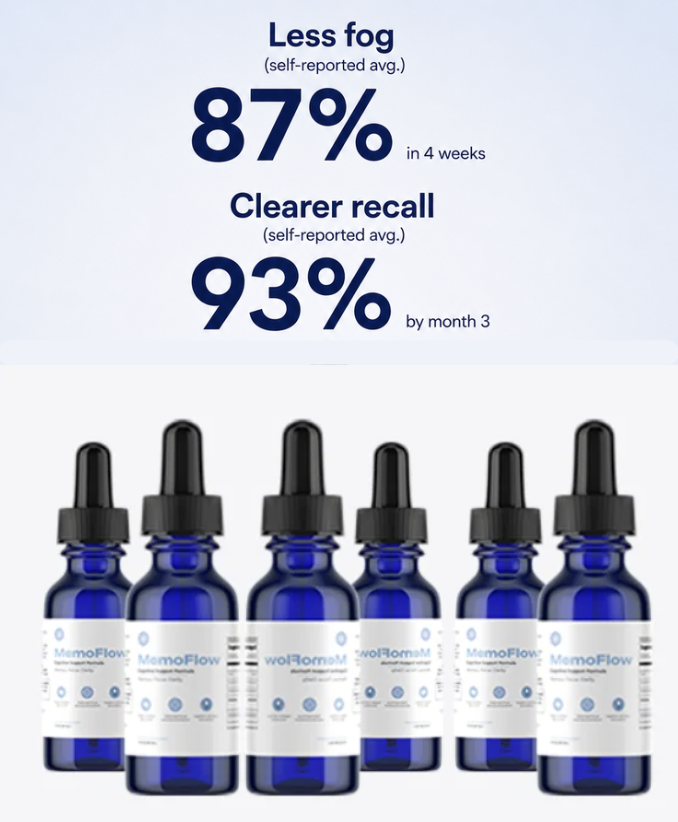
$
19,99
PER
BOTTLE
+ FREE SHIPPING
- 00Days
- 00Hours
- 00Minutes
- 00Seconds
Most Popular
Most Popular
4 BOTTLES
90 Day Supply
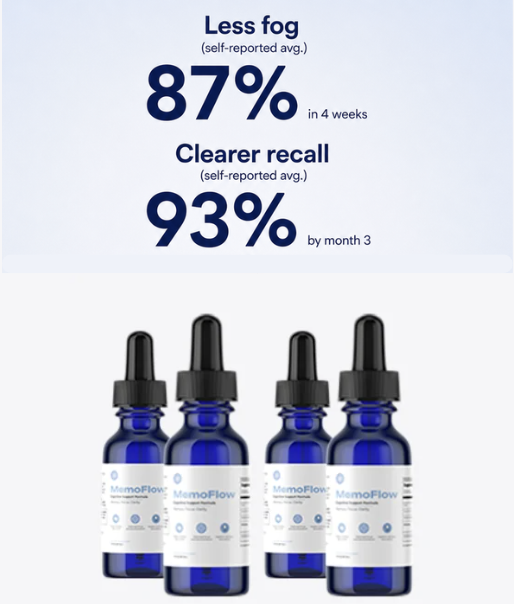
$
24,99
PER
BOTTLE
FREE SHIPPING